Planning
How Much Water to Store for an Emergency
One gallon per person per day. That figure covers drinking and sanitation — the drinking-only minimum is lower, and the distinction matters.

One gallon per person, per day
Drinking and sanitation – and every rehydrated meal draws on the same supply.
Food storage gets the attention. Water is the thing that actually decides how long you can stay put — and it is heavier, bulkier and more urgent than anything in your pantry.
The number
Ready.gov is unambiguous:
“Store at least one gallon of water per person per day for several days, for drinking and sanitation.”
Ready.gov
The CDC gives the same figure for a three-day supply and recommends stretching to two weeks where you have the space.
Worth separating two numbers that often get conflated. The FEMA and American Red Cross guide gives the physiological drinking minimum as two quarts — half a gallon — per person per day. The one-gallon planning figure is that drinking water plus what you need for hygiene, washing and food preparation. Both are right; they are answering different questions.
Who needs more
- Children, nursing mothers and anyone unwell
- Pregnant women
- Pets — count them in your total
- Hot climates: Ready.gov notes that in very hot conditions, water needs can double
What to store it in
The CDC’s container requirements are practical:
- A top that closes tightly
- Durable, unbreakable material — not glass
- A narrow neck where possible, so you can pour rather than dip
Never reuse a container that held a toxic chemical — bleach, pesticides, solvents. To sanitise a container before filling: one teaspoon of unscented household chlorine bleach in one quart of water, swirl to coat, wait at least 30 seconds, empty and air-dry.
Where to keep it
The CDC specifies 50–70°F, out of direct sunlight, and away from petrol and pesticides — vapours can permeate plastic. Label every container “drinking water” with the date you filled it.
How often to replace it
Commercially bottled water: follow the printed date. Water you bottled yourself: replace every six months. Both Ready.gov and the CDC give the same interval.
Treating water when you run out
Ready.gov gives three methods:
- Boiling — a rolling boil for one full minute. The most reliable option.
- Chlorination — 1/8 teaspoon of unscented bleach per gallon, stir, stand 30 minutes. Use bleach with 5.25–6.0% sodium hypochlorite.
- Distillation — boil for 20 minutes and collect the condensate. Slow, but it removes what the other two do not.
The connection to your food plan
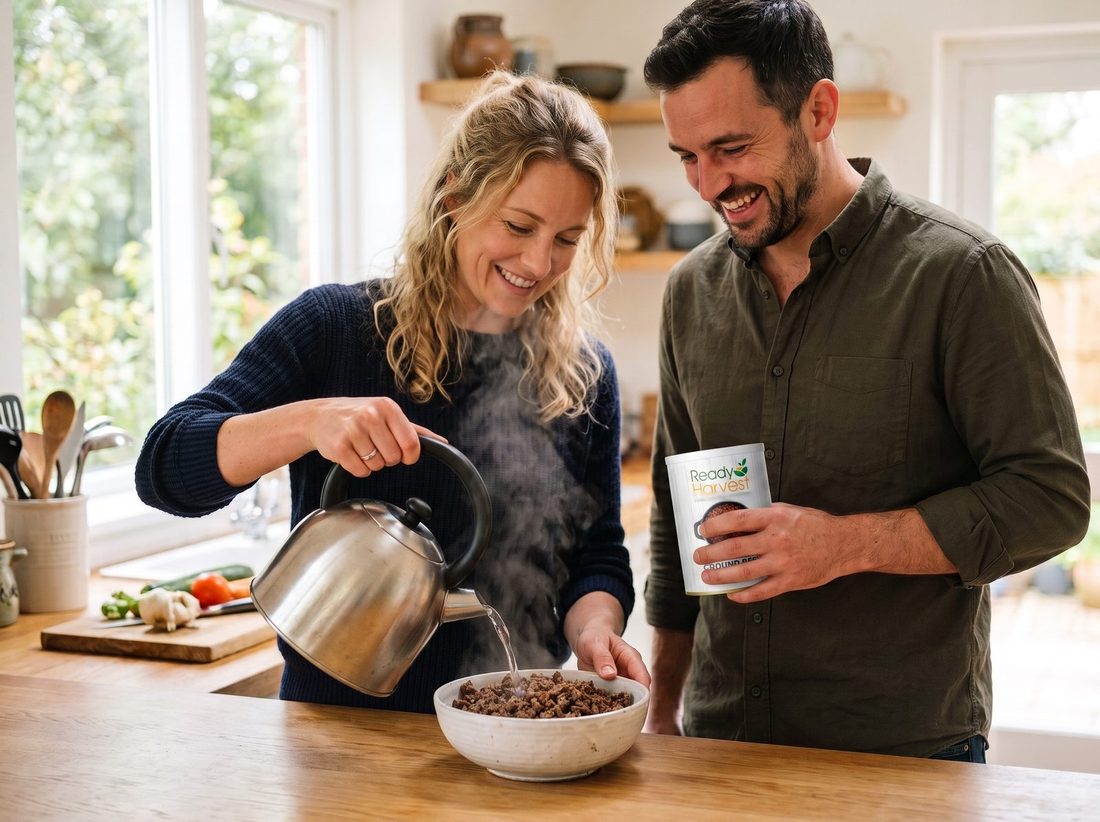
Every rehydrated meal draws on the same supply. Freeze-dried food is light and compact precisely because the water has been taken out — which means you are the one who has to put it back. Build your water plan alongside your food plan, not after it.
Sources: Ready.gov · CDC · FEMA / American Red Cross, Food and Water in an Emergency
Know when it is back in stock
Ready Harvest sells in batches, so the popular cuts go out of stock for weeks at a time. Leave your email and we will tell you when they are back - and when prices move. Nothing else.